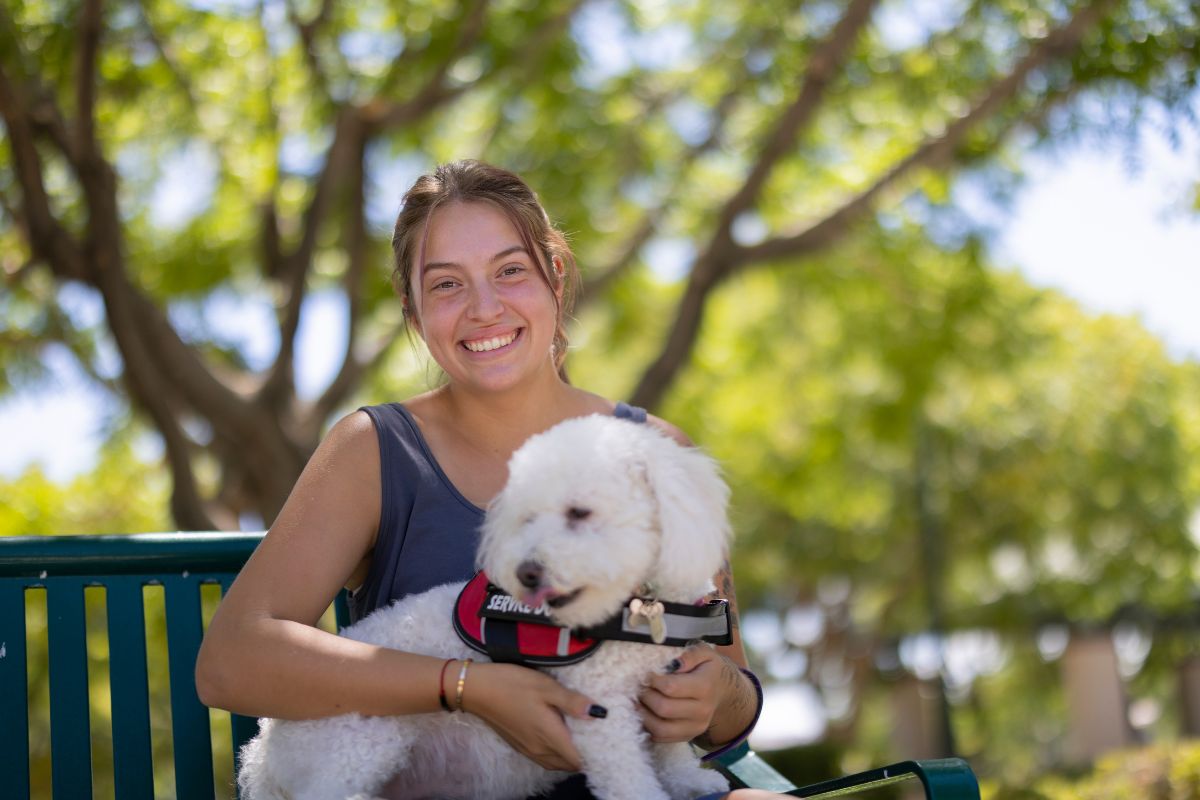
Great service dogs aren’t made alone. Here’s why YOU are the most important part of the equation.
So you’ve decided to train your own service dog. You’ve probably spent hours researching breeds, temperaments, and training methods. And while all of that matters, there’s one piece of the puzzle that often gets overlooked: the human half of the team.
A truly successful service dog partnership isn’t just about a well-trained dog — it’s about two individuals who communicate, trust, and grow together.
Ready to learn what really makes a handler-dog team shine? Let’s fetch some answers.
First Things First: Check Your Own Mindset
Before you focus on teaching your pup to heel, retrieve, or alert, take a moment to check in with yourself. The dogs who excel in service work almost always have one thing in common, and that’s a handler who shows up with patience, consistency, and genuine commitment.
Ask yourself a few honest questions:
- Can I dedicate time to training every single day, even when life gets busy?
- Am I able to stay calm and steady when things don’t go as planned?
- Am I open to learning from my dog, not just teaching them?
If you nodded yes (maybe even out loud, with your dog staring at you wondering why), you’re already starting from a great place.
Trust: It’s a Two-Leash Street
Your service dog will face the world right beside you — busy parking lots, crowded waiting rooms, noisy public spaces. In all of those moments, they’ll be looking to you for signals on how to feel and what to do. That means your dog needs to trust you completely, and that trust has to be earned.
Here’s how to build it:
- Lean into positive reinforcement. Reward what you want to see more of. Dogs are natural people-pleasers (especially when snacks are involved), and they thrive when good behavior leads to good things.
- Be someone your dog can count on. Same cues, same tone, same expectations day after day. Predictability isn’t boring to a dog; it’s reassuring.
- Honor their hard days. Even the most capable, focused service dog can hit a wall. Noticing when your pup needs a breather is the kind of attentive handling that builds a lifelong bond.
Learning to Speak Fluent Dog
Here’s a fun fact that might just change how you see your four-legged teammate: your dog is communicating with you all the time. That yawn mid-training session? The lip lick when a stranger gets too close? The subtle weight shift before a cue? All messages.
The best service dog handlers are excellent listeners. The more you tune in to your dog’s body language, the better you’ll understand how they’re feeling and what they need in any given moment.
On your end, clear communication means:
- Using consistent hand signals and verbal cues
- Giving the cue once — repeating it teaches your dog that the first ask is optional
- Nailing your treat timing so your pup knows exactly which behavior earned that reward
When you both get fluent in each other’s language, the teamwork that follows is magical.
Consistency: Boring Is Beautiful
We know, we know, “be consistent” sounds like the least exciting advice ever. But hear us out, because this one genuinely makes or breaks a service dog team.
Service dogs need to behave reliably everywhere: at home, at the vet, at the farmer’s market, at your in-laws’ house (especially there). Dogs are highly context-sensitive learners, which means a behavior learned in your living room doesn’t automatically transfer to a bustling café. That has to be practiced intentionally and repeatedly.
The good news is that consistency compounds. The more you practice the same rules in the same way, the more natural it becomes for both of you. Eventually, your dog’s responses become second nature and that reliability is exactly what a service dog partnership is built on.
The Underrated Magic of Bonding
The relationship you and your dog share is a training tool in itself.
Dogs who feel secure, loved, and connected to their person are more focused, more willing, and more resilient when the going gets tough. But that connection doesn’t come from drills. It comes from daily walks, cozy evenings on the couch, a good game of tug-o-war, and being part of the family.
When established owner-trainers talk about what makes their partnership special, it almost always comes back to this. You’re starting with a dog that is part of the family from day one. That’s a genuinely beautiful head start.
It’s Okay to Ask for Help (Really!)
Even the most devoted, talented owner-trainers hit bumps along the way. A tricky task, a public access challenge, a training plateau that has you both stumped are completely normal parts of the journey.
Reaching out to a professional service dog trainer isn’t throwing in the towel. It’s one of the smartest things you can do. A good trainer can spot things you might miss, offer fresh approaches, and provide support and accountability. Consider it a power-up for your partnership.
You’re Already the Best Thing for Your Dog
The fact that you’re reading this and thinking carefully about your role as a handler already puts you ahead of the game.
A great service dog partnership takes time, treats, and more than a little patience. There will be proud moments and “we’ll try again tomorrow” moments. But when you and your dog click you’ll know every bit of effort was worth it.
We know you’ve got this but if you need additional support, our local friends at White Mountain College for Pets can help with every step of training your own service dog.